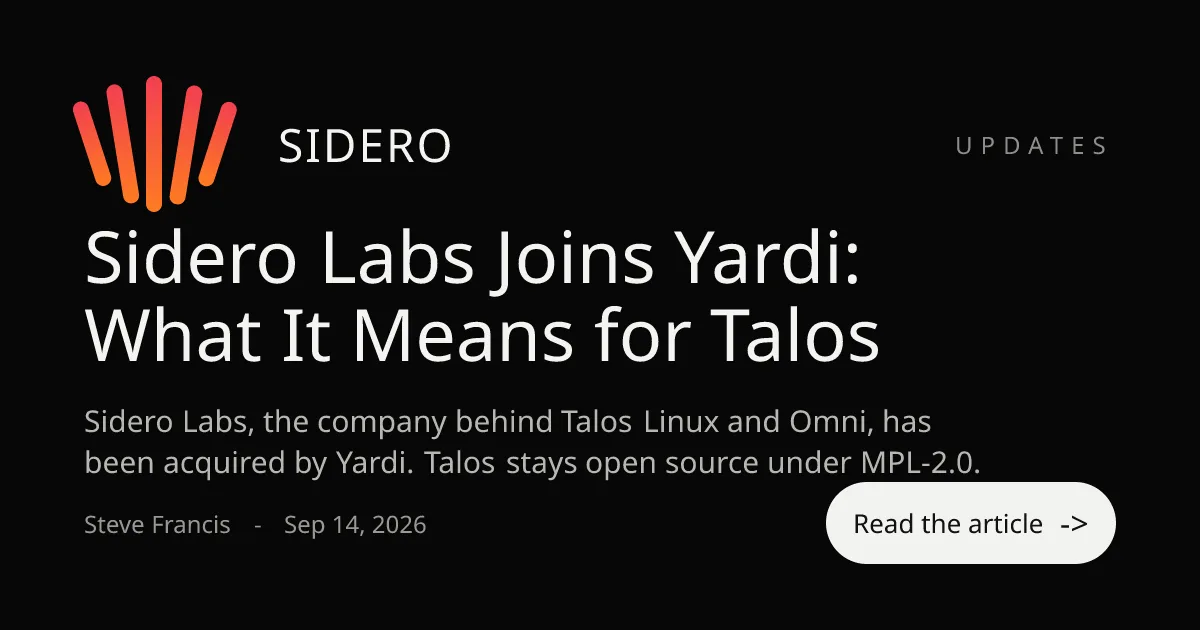
Yardi, the privately held real estate software company, has acquired Sidero Labs, the company behind Talos Linux, an operating system built to run Kubernetes clusters, and Omni, a tool for managing fleets of those clusters. Sidero announced the deal on September 14, 2026.
Financial terms were not disclosed.
Sidero Labs will keep operating as a standalone company inside Yardi, with the same team making day-to-day product decisions. Talos Linux remains open source under the Mozilla Public License 2.0, with the same code repositories and contribution process, and Sidero said it plans to hire more staff of its own.
What Sidero Labs built
Kubernetes is the widely used open-source system for running containerised software across many servers. Sidero Labs was started on the idea that Kubernetes would be simpler to operate if the operating system underneath it were designed only for that job: minimal, secure by default and open source.
The result was Talos Linux. Sidero says that the project took that idea from a concept to a platform, and that tens of thousands of clusters now run on Talos. Omni, its commercial product, lets companies manage many Talos clusters from one place. In the announcement Francis addressed the people who run Talos at work and at home, contribute to it on GitHub and build fleets on Omni, calling them the reason the company exists.
The company traces its origins to Santa Barbara, California, and lists an address in nearby Goleta. Neither Sidero nor the coverage of the deal gave its founding year, headcount or funding history.
“Talos has redefined modern infrastructure by demonstrating that security, simplicity, and openness can coexist. We intend to keep it that way and to give the team and community that built it the resources to finish what they started.”
Why Yardi is buying
Yardi was a Talos user before it was an owner. It was running Talos Linux in production and, according to Sidero, liked the architecture and saw room to develop it further, which was part of why it made the offer. The two companies are also neighbours: Yardi is based in Santa Barbara.
Yardi founder Anant Yardi said Talos had shown that security, simplicity and openness could coexist, and that Yardi intended to keep it that way while giving the team and community the resources to finish what they had started.
For Sidero, the sale answers a question from large customers. In the announcement, Steve Francis of Sidero Labs wrote that enterprises had told the company it was too small and risky to adopt, and had asked what would happen if a buyer bought it and shut the technology down. Joining a profitable company with more than 10,000 employees, he wrote, gives Sidero an answer to both.
The buyer
Yardi makes software for the real estate industry. Anant Yardi built the company over 40 years without outside investors, and it remains bootstrapped, profitable and privately held. Francis pointed to that ownership structure to argue that Sidero would not be squeezed by an owner seeking a quick return.
Francis described Anant Yardi as a long-term operator with a record of buying companies and letting them keep building, and said that was the kind of owner an open-source company could plan around. The deal also means that one of Talos's production users now owns the company that maintains it.
What happens next
Sidero used the announcement to introduce Talos Hypervisor, which extends Talos from containers into virtual machines. The company said the product exists directly because of the Yardi deal.
Sidero also said it will hold a TalosCon conference in the United States early next year, and that it would waive the attendance fee for its Amsterdam TalosCon for people who reposted the announcement. Francis wrote that Sidero could not have afforded either step as a standalone company. Sidero said issues, pull requests and design discussions for Talos will continue in public as before.
For the open-source community, the main commitments are that the licence will not change and that the project will continue to be developed in the open. Francis wrote that the commitment to open source was not changing because of the acquisition.