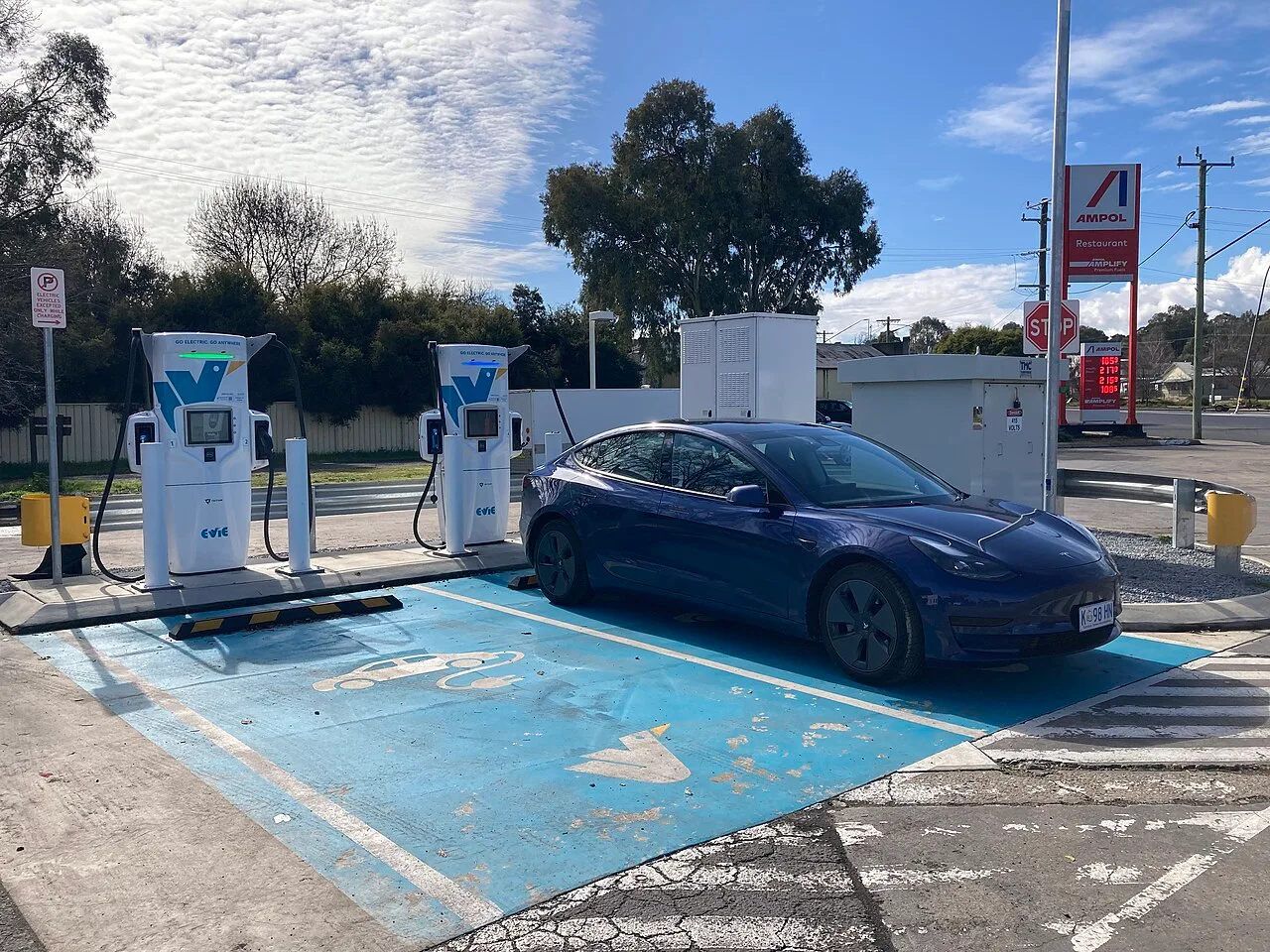
Australian fuel retailer Ampol said on October 1, 2026, that its subsidiary Ampol Energy had signed a share sale agreement to buy all of Fast Cities Australia, the company that trades as Evie Networks, for A$225 million (about US$155 million). Evie describes itself as the largest EV charger network in Australia.
The purchase will be paid for with debt. Completion is targeted for the first half of 2027 and depends on clearance from the Australian Competition and Consumer Commission and other conditions. Until then, both charging networks will keep operating independently, according to electrive.
Evie's more than 1,030 charging bays will be added to Ampol's AmpCharge network, giving the combined business about 1,425 bays across more than 400 sites. Ampol expects full integration to take three years.
What Evie Networks built
Evie was founded in 2017 by Paul Fox and Rodger Whitby and has offices in Sydney, Melbourne and Brisbane. It built a network of public fast and ultra-fast chargers, mostly in metropolitan areas, according to The Driven.
Its early expansion relied on public support as well as private money. In 2019 the Australian Renewable Energy Agency committed A$15 million (about US$10 million) toward a A$50.2 million (about US$35 million) project covering 42 ultra-fast charging sites. In September 2025 the company secured a A$50 million (about US$35 million) debt facility from Infradebt, an infrastructure lender backed by Mike Cannon-Brookes, Startup Daily reported.
Fox once wrote that Evie, as an early mover, had to build chargers before there was demand for them and used venture capital to prove the model.
“The acquisition secures a portfolio of well-located sites with long-dated average lease tenure and established grid access that we believe will become increasingly valuable as BEV adoption accelerates in the years ahead.”
The backers
Trevor St Baker's Energy Innovation Fund was Evie's main investor and its largest shareholder. Startup Daily reported that Evie raised a A$500,000 (about US$345,000) seed round in 2017 and a A$7 million (about US$4.8 million) Series A in 2018, and that St Baker invested more than A$100 million (about US$69 million) in the company in total.
The Driven reported that St Baker, a former coal magnate who also backed the fast-charger maker Tritium, is believed to hold about 80% of Evie, with motoring club RACQ holding a small stake and staff owning the rest. Ampol chief executive Matt Halliday described St Baker as a pioneer of the Australian EV charging industry.
Why Ampol is buying
Ampol has been building its own charging network under the AmpCharge brand. Halliday said the deal gives the company sites with long average lease terms and existing grid connections, which he expects to become more valuable as battery electric vehicle adoption grows.
Evie's sites have a weighted average remaining lease term of about 10 years, and some have spare grid capacity for expansion. Ampol expects its combined Energy Solutions and Evie operations to reach annualised EBITDA of A$30 million (about US$21 million) within three years of completion, including about A$10 million (about US$7 million) of savings, mostly from lower costs. It forecasts the combined charging business will break even in 2028.
Halliday also said that public charging infrastructure is a precondition for wide electric vehicle adoption, according to The Driven. Evie chief executive Chris Mills told the publication that the company knows where there is unmet demand for charging, and said St Baker was very happy with the sale.
Ampol said in its ASX announcement that the purchase will be fully funded with debt, that it remains committed to its Baa1 investment-grade credit rating, and that it expects the deal to have only a nominal effect on its leverage.
A growing market for public charging
The deal comes as electric vehicles take a larger share of the Australian car market. The Driven reported that EVs reached a record 24.8% of new car sales in August 2026 and averaged about 20% over the previous five months.
Halliday framed the purchase as a question of timing, saying in Ampol's statement that EV charging comes down to disciplined investment at the right time. The competition regulator's review will now decide whether the deal can go ahead.